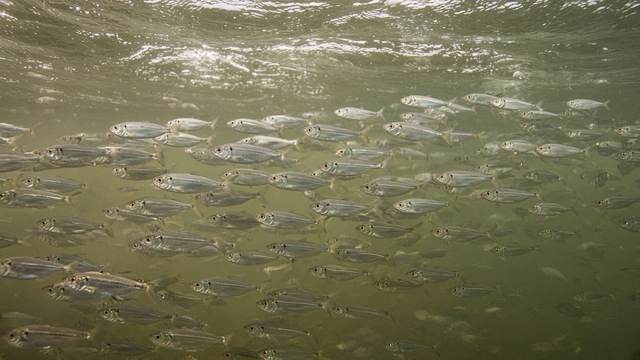
NEWPORT, RHODE ISLAND — Coastwide menhaden harvest limits for 2027 through 2029, and the size of the Chesapeake Bay’s industrial reduction cap, go to final votes next week at the Atlantic States Marine Fisheries Commission’s annual meeting in Newport, Rhode Island.
The Atlantic Menhaden Management Board is scheduled for final action on Nov. 10 and Nov. 11 at Hotel Viking. The board’s first block sets specifications for the 2027–2029 fishing years after a Technical Committee review of stock projections. The same sessions take up Draft Addendum II on the Chesapeake Bay Reduction Fishery Cap for final approval, with the Addendum II work continuing on Nov. 11 if needed. The commission’s 84th Annual Meeting runs Nov. 9–12 and is hybrid, with board proceedings also broadcast by webinar.
Maryland’s stake is measured in forage and bait as much as in quota share. Under Addendum I allocations, Maryland holds 1.17 percent of the coastwide total allowable catch; Virginia holds 75.21 percent. The Potomac River Fisheries Commission holds 1.09 percent. Menhaden are forage for striped bass, bluefish and weakfish and are used as commercial bait in crab, lobster and hook-and-line fisheries, the commission says.
The 2026 coastwide total allowable catch is 186,840 metric tons, a 20 percent cut from the 2023–2025 level. Commission materials say that level carries a 0 percent chance of overfishing in 2026 but a 100 percent probability that fishing mortality sits between the ecological reference point target and threshold. The stock is not overfished and overfishing is not occurring relative to those reference points, as re-estimated in the 2025 ERP benchmark assessment; the 2025 single-species assessment update, with a 2023 terminal year, reaches the same finding. The current Bay Cap on reduction harvest inside the Chesapeake stands at 51,000 metric tons.
If the board does not set a 2027 total allowable catch by Dec. 31, 2026, next year’s catch limit automatically stays at 186,840 metric tons, according to an Oct. 21 Technical Committee memorandum in the board materials. Projection tables prepared for the board show that holding that status-quo tonnage through 2027–2029 carries a 99.5 percent probability of exceeding the ecological reference point fishing-mortality target in each of those years, with a 0 percent probability of exceeding the fishing-mortality threshold. A catch limit of 114,200 metric tons a year for 2027–2029, about 39 percent below 2026, is the level tied to a 50 percent probability of exceeding the fishing-mortality target.
Draft Addendum II, already out for public hearings this fall, considers options to reduce the Bay Cap by up to 50 percent and to spread remaining reduction harvest more evenly through the season. No outcome is locked until the board votes. Maryland fishery managers and the Potomac River Fisheries Commission hosted the state’s Sept. 15 hearing in Annapolis; written comment on the draft closed Oct. 9.
Meeting materials and webinar registration are posted on the commission’s Annual Meeting page. Part 1 of the menhaden board materials covers the agenda, specifications and reallocation materials; Parts 2 and 3 carry Draft Addendum II, hearing summaries and submitted comments.
Source: Atlantic States Marine Fisheries Commission
Also: Atlantic States Marine Fisheries Commission (2), Atlantic States Marine Fisheries Commission (3)
Drawn from public records; drafted with AI and edited by Peter Gorman before publication.
Comments
Signed comments are held for review, then published. Obvious spam is rejected before it reaches the editor. Letters and comments.
No published comments yet.