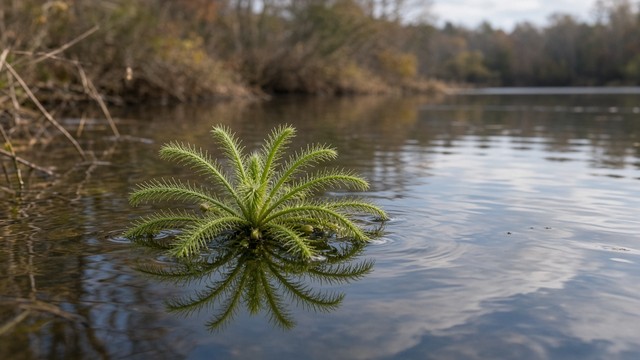
EASTON, MARYLAND — Maryland would bar anyone from bringing in, keeping, growing or selling a carnivorous floating pond plant called waterwheel and a large Asian freshwater mussel without a state permit, and from releasing either into state waters, under proposed rules from the Department of Natural Resources. The public can comment through Nov. 30.
The plant and the mussel would join the state's most restrictive group of nonnative aquatic species. The department says its risk assessments found both could do significant harm if they became established here. A permit could be granted only with proof that the organism is free of communicable disease, and a permitted plant or mussel could be kept only in a secure facility from which it cannot escape into state waters. No permit would be needed to take a specimen, dead or in a sealed container, to the department or another place the secretary directs so it can be identified or reported. Specimens lawfully acquired dead would also be exempt, as long as any plant seeds are removed or sealed, or the plant is preserved as a herbarium or museum specimen.
Waterwheel is a rootless, free-floating plant with whorls of bristled leaves that trap small prey. It is native to Eurasia, Africa and Australia, has been grown by carnivorous-plant hobbyists in outdoor ponds since the 1980s, and has been found in Virginia, where the department says it has shown highly invasive tendencies. Plants can double in mass in as little as 12 days. Whole plants, fragments or overwintering buds can be carried by birds, flowing water, or boats and other recreation gear. Thick growth could shade out native underwater plants and clog waterways used for fishing, boating and irrigation, the department says.
The Chinese pond mussel, native to eastern Asia, competes with native freshwater mussels for space, food and the host fish its larvae depend on. Where it has become established, it can make up as much as 90% of the total biomass of unionid freshwater mussels. The department says many of Maryland's native mussels are already imperiled.
The same proposal widens the swamp eel listing from one species, the Asian swamp eel, to the entire swamp eel family, because several related species move through live-food markets and the aquarium trade. The department says the two most commonly traded species can breathe air, tolerate brackish water and survive freezing temperatures, so they could likely make it through a Maryland winter. It would also take candiru, a South American parasitic fish, off the banned list after finding it a lower risk than first feared; the department says the tropical fish is not found in the United States and is unlikely to survive Maryland winters.
A second proposal would let the department run pilot projects to test new ways of managing invasive species. The first planned pilot would allow a commercial licensee to sell invasive fish such as blue catfish, flathead catfish and Northern snakehead, which Maryland calls Chesapeake Channa, that are collected in a fish lift. The department says fish lift work at Conowingo Dam on the lower Susquehanna River has removed thousands of snakehead and flathead catfish, which are now euthanized and given to processors for human consumption, but that the arrangement depends on uncertain federal funding and state resources. Participants would need a pilot program permit and would have to follow its conditions, and the department would report on each pilot in its annual fisheries report to the General Assembly.
Both proposals were printed in the Maryland Register on Oct. 30, opening a 30-day comment period that ends Nov. 30. No public hearing has been scheduled. The department projects both changes could take effect in early 2027 if adopted. Comment forms for each proposal are linked from DNR's fishing-regulations changes page, and comments can also be mailed to the department's Fishing and Boating Services regulatory staff at 580 Taylor Avenue, E-4, Annapolis, MD 21401.
Source: Maryland Department of Natural Resources
Drawn from public records; drafted with AI and edited by Peter Gorman before publication.
Comments
Signed comments are held for review, then published. Obvious spam is rejected before it reaches the editor. Letters and comments.
No published comments yet.