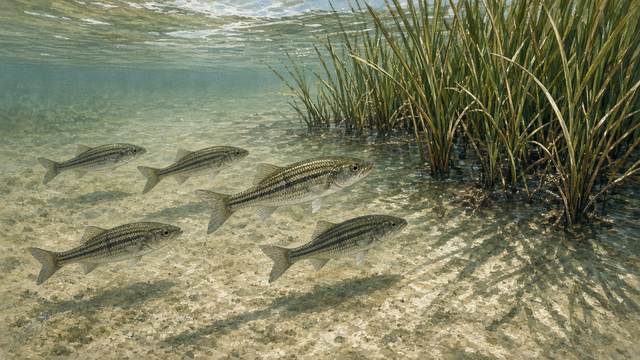
ANNAPOLIS, MARYLAND — Maryland's count of young striped bass rose this year to its highest level since 2018, but the state's annual survey still came in below average for the eighth year in a row, the Maryland Department of Natural Resources said Oct. 19. The Choptank River was one of the two best-performing areas.
DNR's 2026 juvenile striped bass survey recorded a young-of-year index of 5.5. The index is the average number of juvenile striped bass 3 inches or smaller caught per sweep of a seine net. The survey's long-term average is 10.8; the index was 4.0 in 2025 and 2.0 in 2024.
Biologists caught 723 juvenile striped bass this year. DNR named the upper Bay and the Choptank River as the highest-performing areas. Catches were below average, the department said, but the young fish were more widely spread than in recent years, a sign of suitable habitat throughout the nursery areas.
The Choptank is one of four spawning areas in the survey, along with the Nanticoke and Potomac rivers and the upper Chesapeake Bay. DNR's survey page lists 22 fixed stations, four of them on the Choptank. Crews visit each site three times a summer and make two sweeps with a 100-foot beach seine, for 132 sweeps in all. The survey has run in Maryland's part of the Bay since 1954. The release does not break out a separate Choptank count.
"We are encouraged to see some improvements to the numbers of juvenile striped bass this year, while it wasn't as robust as we would like," said Michael Luisi, director of DNR's Fishing and Boating Services. "Ongoing low recruitment is anticipated to impact rebuilding of the coastwide striped bass population."
DNR pointed to the weather. Cold winters and wet springs tend to help spawning, and Maryland had a cold winter, but the release said the prolonged regional drought and low river flows may have left unfavorable conditions for striped bass eggs and larvae. A shortened spawning period could also have played a role.
Other fish did better. Biologists caught nearly 72,000 fish of 61 species. Young Atlantic menhaden were found in abundance, Atlantic silversides turned up in their highest numbers in more than a decade, and American shad reproduction was above average in the Potomac River and upper Bay.
Across the state line, the Virginia Institute of Marine Science recorded a mean of 9.52 young striped bass per seine haul in Virginia's Bay tributaries this year, up from 5.12 in 2025 and close to that survey's historical average of 7.77.
DNR said the run of below-average year classes will likely become more apparent in the adult population as these fish mature. A benchmark stock assessment for the coastwide Atlantic striped bass population is underway and expected to complete peer review in spring 2027, and the department said continued low reproduction will influence future conservation measures under consideration by the Atlantic States Marine Fisheries Commission.
Source: Maryland DNR
Also: Maryland DNR (2), VIMS
Drawn from public records; drafted with AI and edited by Peter Gorman before publication.
Signed comments are held for review, then published. Obvious spam is rejected before it reaches the editor. Letters and comments.
No published comments yet.