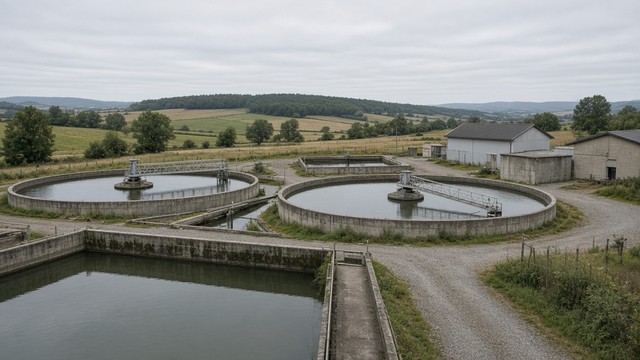
TRAPPE, MARYLAND — Trappe's wastewater plant and Talbot County's septic-upgrade program are both on the agenda when Maryland's Board of Public Works meets Nov. 18, with up to $974,500 combined in Bay Restoration Fund grants proposed for Talbot.
The larger item asks the board to approve up to $679,500 for the Town of Trappe to pay for design services on an Enhanced Nutrient Removal upgrade at the Trappe Wastewater Treatment Plant, according to the agenda posted by the board and updated Nov. 9. The Maryland Department of the Environment is recommending the grant.
The project would keep the plant at its existing design capacity of 0.2 million gallons per day while building a new treatment train, rehabilitating existing process basins, adding secondary clarifiers and upgrading SCADA, electrical and chemical systems, the agenda says. Once the upgrades are finished, the plant would be able to reach an effluent goal of 3.0 milligrams per liter for total nitrogen and 0.3 milligrams per liter for total phosphorus. The agenda says that would mean a 77% reduction in total nitrogen discharged to an unnamed tributary to La Trappe Creek, which flows to the Choptank River and the Chesapeake Bay.
The agenda lists the project's total cost at $705,475: this grant plus $25,975 from the same fund that the board approved in May 2019. The money covers design. The agenda does not include a construction cost.
The second item is a statewide package of $2,738,800 from the Bay Restoration (Septic) Fund for fiscal 2027, to help property owners replace septic systems with Best Available Technology units that remove nitrogen and to connect homes to sewer. Talbot County's award on the list is $295,000. The package also includes $125,000 for Caroline, $250,000 for Dorchester and $100,000 for Kent.
Failing systems and holding tanks in the Chesapeake and Atlantic Coastal Bays Critical Area get first priority under the program, the agenda says. Residential owners can receive grants covering 50% to 100% of the cost of Best Available Technology, depending on household income. The state program described in the agenda covers 100% of drainfield projects for low-income homeowners and up to $5,000 for moderate-income homeowners, but Talbot County's septic-fund page says drainfield work is covered only for low-income applicants. For new construction, the county's guidance says the owner is responsible for a $1,200 deductible from the grant amount. Talbot homeowners must first apply to the county's Office of Environmental Health for a sanitary construction permit, then submit the grant paperwork to the Department of Public Works.
The board meets online and in the Governor's Reception Room at the State House in Annapolis. Its agenda notes that items may be addressed partly or wholly in closed session.
Source: Maryland Board of Public Works
Drawn from public records; drafted with AI and edited by Peter Gorman before publication.
Comments
Signed comments are held for review, then published. Obvious spam is rejected before it reaches the editor. Letters and comments.
No published comments yet.