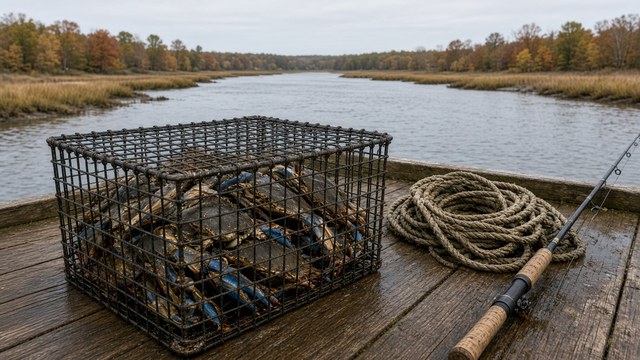
EASTON, MARYLAND — Deeper tidal-river water, about 20 feet down, is in the mid-60s and is holding some of the largest blue crabs seen in years, the Maryland Department of Natural Resources said in its Nov. 11 fishing report.
The report calls it an unusual November crab catch, noting that crabbing this time of year is usually left to commercial crab potters. Commercial crabbers are doing well, working to make up for a poor oyster market, and recreational crabbers are catching jumbo crabs in the tidal creeks and rivers too. Recreational crabbers say some crabs drop off on the way up from the depths, but plenty hang on, the report said.
Blue catfish fishing is also good in the upper Choptank River, from about the Dover Bridge area up to Denton and up the Tuckahoe past the Route 328 bridge, the report said. Most of the blue catfish being caught there run 16 to 20 inches, which the report calls a good eating size. Channel catfish and white catfish are also in the mix.
Striped bass fishing in shallow water remains good to excellent in the middle Bay. Eastern Bay, the lower Miles, the Choptank, the Little Choptank and the Severn are among the places named. Anglers are also reporting breaking fish and diving gulls in Eastern Bay and around the False Channel area. Baitfish are moving out of the tidal rivers at a slower pace because the water there is hovering around 60 degrees.
White perch are schooling in the lower sections of the region's creeks, usually near the mouths in 20 feet of water or more, often over a lump or oyster reef. At that depth the water is usually 5 to 7 degrees warmer than at the surface, the report said.
The weekly report is compiled by Keith Lockwood, a DNR fisheries biologist.
Source: Maryland Department of Natural Resources
Drawn from public records; drafted with AI and edited by Peter Gorman before publication.
Comments
Signed comments are held for review, then published. Obvious spam is rejected before it reaches the editor. Letters and comments.
No published comments yet.